
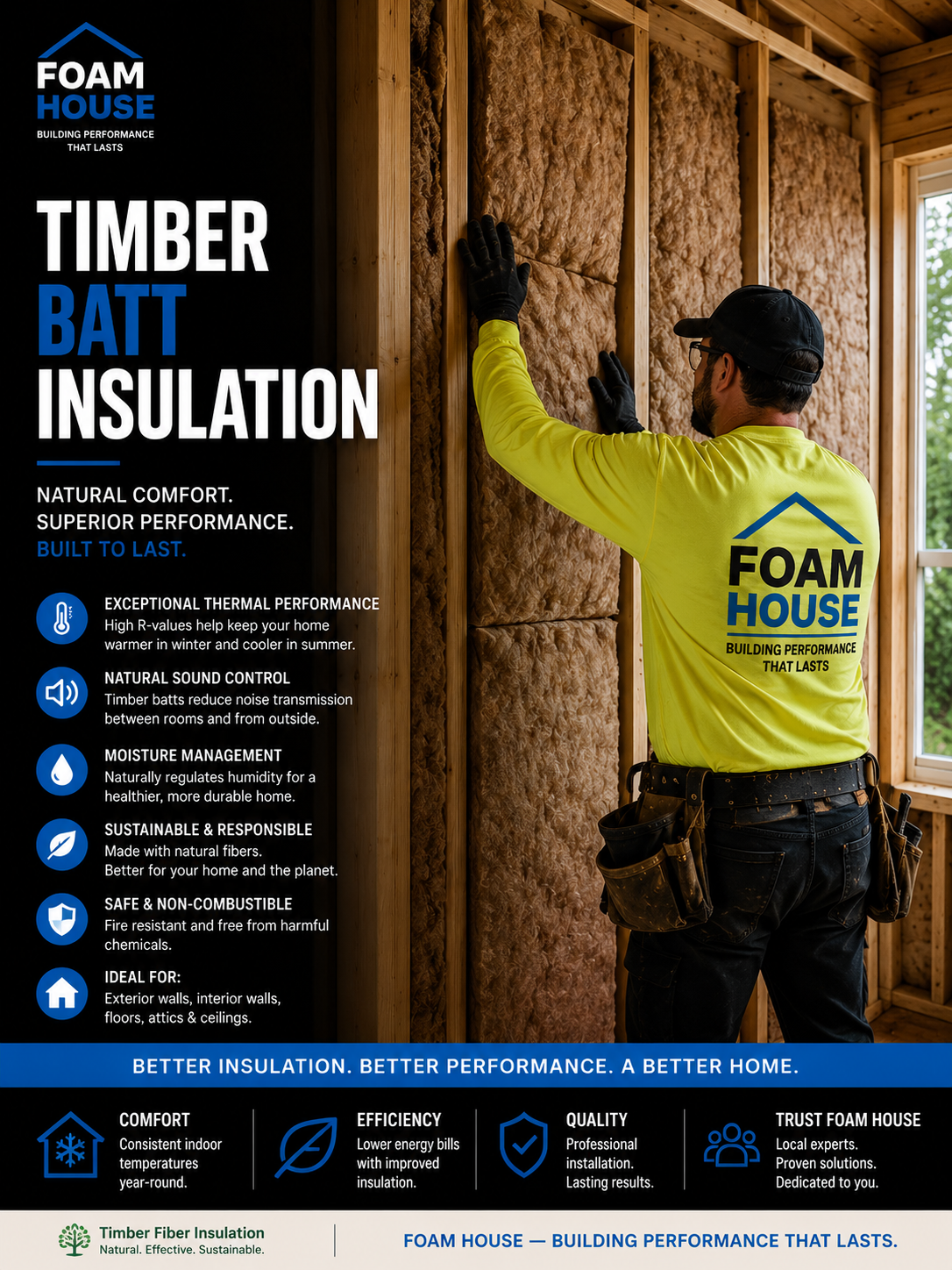
What Makes Timber Batt Insulation Unique?
High Thermal Mass
Unlike fiberglass, timber fiber stores heat before releasing it slowly. This delays heat moving through walls and roofs, making homes noticeably cooler during hot summer afternoons.
Excellent Moisture Management
Wood fibers naturally absorb and release moisture without losing much insulating performance. This helps regulate humidity and reduces condensation risk in properly designed wall systems.
Superior Summer Comfort
Because timber fiber slows heat transfer (high phase shift), it performs exceptionally well in hot climates and under roof assemblies where the sun beats down all day.
Sustainable Material
Timber batts are manufactured from renewable wood fibers, often sourced from sustainably managed forests, making them one of the lowest-carbon insulation products available.
Better Acoustics
The dense, fibrous structure absorbs sound more effectively than fiberglass, improving indoor comfort and reducing noise transmission.
Vapor Open Construction
Timber fiber is commonly used in high-performance wall assemblies that allow buildings to dry naturally, making it popular in passive house and European building systems.
Foam House Perspective
Timber fiber insulation is not simply another batt insulation—it is part of a high-performance natural building envelope. It excels in projects where long-term durability, moisture management, summer comfort, and sustainability are priorities.
What Makes Timber Batt Insulation Unique?
High Thermal Mass
Unlike fiberglass, timber fiber stores heat before releasing it slowly. This delays heat moving through walls and roofs, making homes noticeably cooler during hot summer afternoons.
Excellent Moisture Management
Wood fibers naturally absorb and release moisture without losing much insulating performance. This helps regulate humidity and reduces condensation risk in properly designed wall systems.
Superior Summer Comfort
Because timber fiber slows heat transfer (high phase shift), it performs exceptionally well in hot climates and under roof assemblies where the sun beats down all day.
Sustainable Material
Timber batts are manufactured from renewable wood fibers, often sourced from sustainably managed forests, making them one of the lowest-carbon insulation products available.
Better Acoustics
The dense, fibrous structure absorbs sound more effectively than fiberglass, improving indoor comfort and reducing noise transmission.
Vapor Open Construction
Timber fiber is commonly used in high-performance wall assemblies that allow buildings to dry naturally, making it popular in passive house and European building systems.
Foam House Perspective
Timber fiber insulation is not simply another batt insulation—it is part of a high-performance natural building envelope. It excels in projects where long-term durability, moisture management, summer comfort, and sustainability are priorities.